
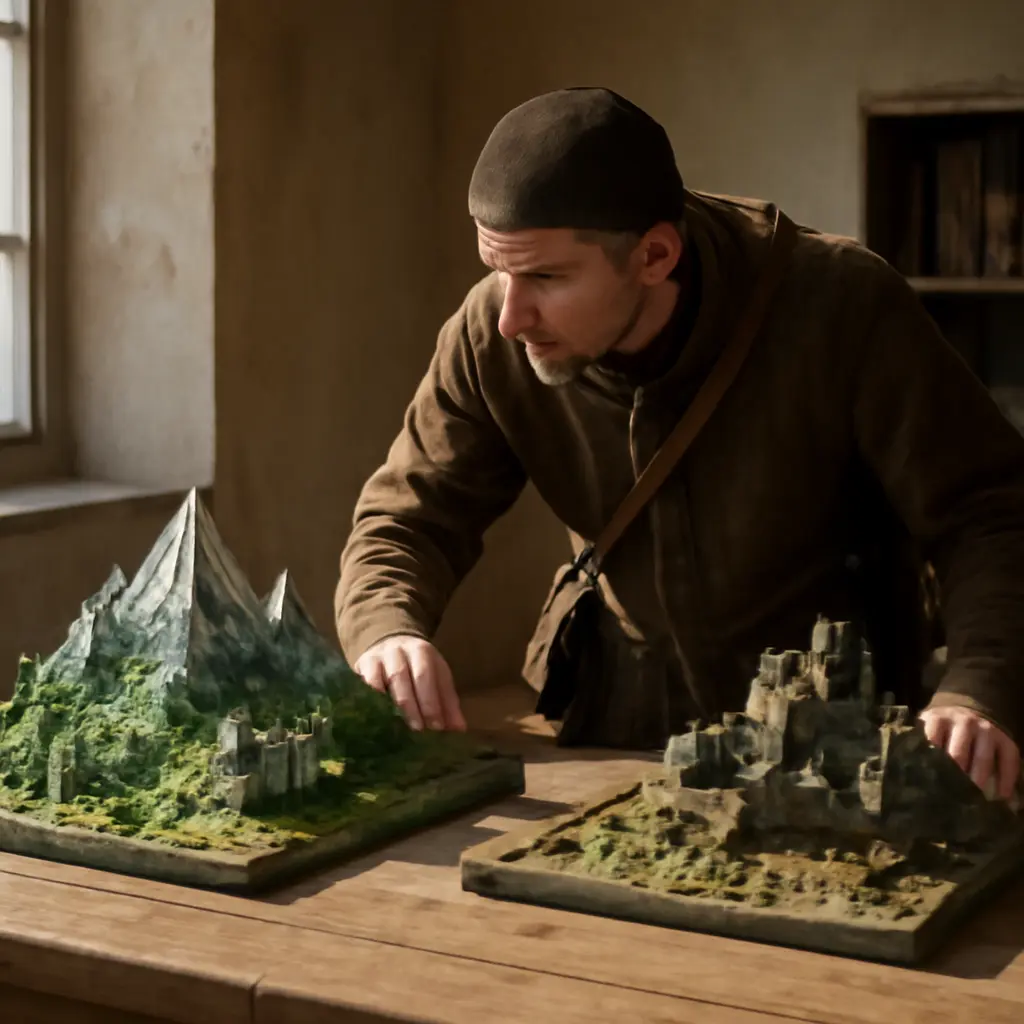
Grimdark and high fantasy are ways of shaping a fantasy world, not simply labels for how violent or magical a story is. High fantasy usually places imagined worlds, large-scale conflicts, and distinctive systems of magic at the center; grimdark emphasizes brutal conditions, compromised choices, and uncertain moral outcomes. The distinction is best understood through tone, power, morality, and the possibilities a world offers its inhabitants—not through a rule that one must be hopeful and the other hopeless. Fantasy scholarship and publishing use these terms in varied ways, so the examples below treat them as useful conventions rather than rigid categories.
High Fantasy and Grimdark: How Worldbuilding Sets Them Apart
High fantasy defines the scale and setting
High fantasy generally describes stories set primarily in a secondary, invented world, where the setting’s history, societies, and supernatural rules are integral to the narrative. The term is often associated with a sweeping scope: kingdoms, peoples, wars, journeys, or threats that affect entire regions. These features do not require a cheerful tone. A high-fantasy world can be tragic, frightening, or politically ruthless.
Literary critic Farah Mendlesohn, in Rhetorics of Fantasy (2008), examines fantasy through the ways imagined worlds and their impossible elements are presented to readers. That approach helps clarify why setting matters: high fantasy is not merely a story with a spell or a mythical creature. Its invented world often shapes the characters’ identities, conflicts, and understanding of what is possible.
Grimdark defines a bleak moral and social lens
Grimdark is a tonal and thematic label for fiction that foregrounds harsh systems, pervasive violence, compromised agency, and morally ambiguous decisions. Its worlds may contain magic, empires, or epic wars, but those elements are often presented through the costs they impose: exploitation, trauma, corruption, or the suffering of ordinary people. The term is commonly linked to Warhammer 40,000’s slogan, “In the grim darkness of the far future, there is only war,” though contemporary fantasy uses it more broadly.
Unlike high fantasy, grimdark does not require a secondary world or a continent-spanning quest. It is possible to write grimdark in a small, intimate setting, and a vast epic can be grimdark if its institutions and choices create a sustained sense of brutality or moral uncertainty. The label is therefore about emphasis, not a checklist of violent content.
Worldbuilding Separates Grimdark and High Fantasy Through Tone, Power, and Hope
Tone: wonder, dread, and the cost of conflict
Tone is the emotional atmosphere a story establishes. High fantasy often makes room for wonder: ancient ruins, unfamiliar cultures, extraordinary magic, and journeys into the unknown. Grimdark tends to direct attention toward danger, deprivation, and the consequences of violence. These are tendencies, not mutually exclusive traits. A high-fantasy adventure can include horror, while a grimdark story can contain beauty, affection, humor, or moments of awe.
A useful comparison is the function of a battle. In a more conventionally heroic high fantasy, conflict may test courage and enable a community’s defense. In grimdark, the same battle may expose the political interests behind a war, show the damage inflicted on civilians, or leave victory morally compromised. The difference lies less in whether a battle occurs than in how the narrative frames its causes and aftermath.
Power: what magic and institutions do to people
Magic, monarchy, religion, and military force are worldbuilding tools in both modes. High fantasy may present magic as a source of mystery, a discipline to master, or a power tied to the world’s cosmology. Grimdark often stresses who controls such power, who pays for it, and how institutions use it. A magical cure, for instance, can be a source of hope in one story and a scarce resource controlled by elites in another.
This contrast can be seen in the settings of J. R. R. Tolkien’s The Lord of the Rings and George R. R. Martin’s A Song of Ice and Fire. Tolkien’s work is a foundational example of high fantasy, with an invented world, a history reaching beyond the immediate plot, and a central struggle against a powerful evil. Martin’s series likewise uses a vast secondary world, but its dynastic conflicts, political calculation, and recurring human costs are often associated with grimdark or grimdark-adjacent fantasy. Neither example reduces neatly to a single feature: both include violence, loyalty, courage, and loss.
Morality and hope: outcomes are not genre tests
High fantasy is often linked with moral contrasts and the possibility of meaningful resistance, but it need not promise an uncomplicated happy ending. Grimdark frequently makes moral choices difficult by placing characters in systems where every available option carries harm. Still, grimdark does not mean that goodness is impossible, and high fantasy does not mean that goodness always wins.
Hope is best treated as a question of narrative possibility. Does the world allow people to repair damage, build solidarity, or change oppressive conditions? A story may show little hope at the political level while preserving it in personal relationships. Conversely, a high-fantasy victory may defeat a particular villain without resolving the deeper injustices that made the conflict possible.
Related Fantasy Types Show Why the Labels Overlap
Epic fantasy and heroic fantasy emphasize different features
Epic fantasy usually signals breadth and consequence: a large cast, extended history, consequential wars, or threats spanning nations. It often overlaps with high fantasy because both commonly use secondary worlds, but “epic” describes scale more directly than moral tone. Heroic fantasy, meanwhile, foregrounds a protagonist’s feats, tests, or adventures. Either form can be hopeful, tragic, or grim.
Dark fantasy and grimdark are related, but not identical
Dark fantasy blends fantasy with horror, gothic atmosphere, or disturbing supernatural elements. Grimdark instead points primarily to bleakness, brutality, and moral compromise. A dark fantasy may be frightening because monsters threaten a community, yet still offer a clear moral purpose and a route to safety. A grimdark political drama may contain no horror creatures at all. Stories can, of course, belong to both categories.
Low fantasy contrasts through its relationship to the ordinary world
Low fantasy is commonly used for fantasy in which supernatural elements enter a largely recognizable or non-secondary-world setting, though definitions vary among critics and readers. The distinction concerns the setting’s relation to the ordinary world, not how dark or uplifting the story feels. Low fantasy can be grim, and high fantasy can be lighthearted.
A Practical Test for Classifying a Fantasy World
When comparing two stories, ask what each label is describing. “High fantasy” usually tells you about the prominence of an invented world and its scope; “grimdark” tells you about the world’s tone and moral pressures. Consider these questions:
- Is the story principally set in a fully imagined secondary world?
- Does the plot operate on a personal, regional, or world-shaping scale?
- Does the narrative emphasize wonder and discovery, or systemic cruelty and compromised choices?
- Are violence and power shown mainly as obstacles to overcome, or as structures that reproduce harm?
- Does the ending leave meaningful room for reform, solidarity, or hope?
These questions produce a more precise description than a single label. A sprawling secondary-world saga with brutal politics might be called high fantasy with grimdark elements. A bleak supernatural novella set in a recognizable city may be dark fantasy without being high fantasy. Genre terms work best as maps for reader expectations, not as boxes that stories must fit perfectly.
Conclusion: Grimdark Is a Lens; High Fantasy Is Often a World and Scale
The real difference between grimdark and high fantasy is that they often describe different dimensions of a story. High fantasy points toward an invented world and, frequently, a broad scope; grimdark points toward a bleak tone, brutal power structures, and morally difficult choices. Epic, heroic, dark, and low fantasy add further distinctions, but their boundaries overlap. To read or write fantasy more precisely, look at the setting, the role of power, the framing of violence, and the kinds of hope the narrative permits. For further exploration, compare works across these dimensions and consult fantasy criticism such as Farah Mendlesohn’s Rhetorics of Fantasy.
Sources: Farah Mendlesohn, Rhetorics of Fantasy, Wesleyan University Press, 2008, https://www.weslpress.org/9780819569343/rhetorics-of-fantasy/; J. R. R. Tolkien, The Lord of the Rings, HarperCollins, https://www.harpercollins.com/products/the-lord-of-the-rings-j-r-r-tolkien; George R. R. Martin, A Song of Ice and Fire, Bantam Books, https://georgerrmartin.com/book-category/a-song-of-ice-and-fire/; Warhammer Community, “What Is Warhammer 40,000?”, https://www.warhammer-community.com/warhammer-40000/